Bell Ringers
“If You Want to change the world Don’t ever, Ever, Ring The Bell”
These are the words from retired four star Navy admiral, Admiral William H. McRaven. He spoke these words in his 2014 commencement address at the University of Texas at Austin. In that address, Adm. McRaven explains how “ringing the bell” represented quitting during Navy SEAL training. If the training ever felt too hard, all someone needed to do was ring the bell and quit. Hence, ringing the bell represented the sound of giving up; and for years I was bought into that ideology… until I learned about one man: Washington McLean Gadsden.
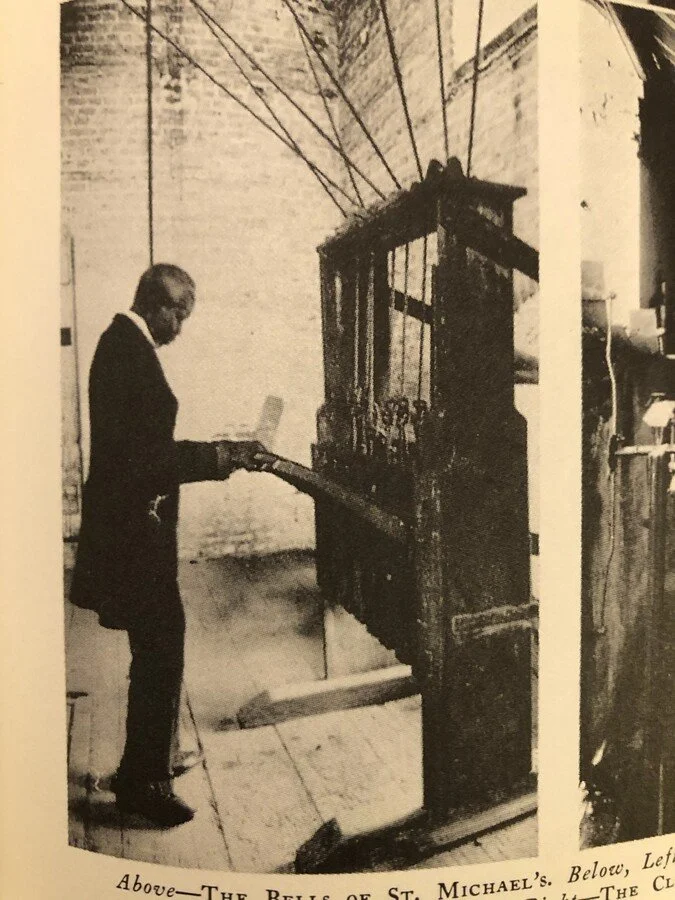
Photo of Washington McLean Gadsden ringing the church bells. Photo accessed from the College of Charleston.
Washington McLean Gadsden was a black man who was born into slavery in 1824. While enslaved, Gadsden served at St Michael’s Episcopal Church in Charleston, SC (this church is currently the oldest church building that’s still standing in Charleston). Nonetheless, what’s so special about Gadsden, you ask. Well get this…
Washington McLean Gadsden was a Professional Bell Ringer.
Starting at age 13, Gadsden along with other enslaved boys would ring the St. Michael’s church bells for all of Charleston to hear. Ringing songs like “Home Again” and “Auld Lang Syne,” Gadsden was famous for his bell ringing. During times of hardship, Charlestonians would pause and listen to Gadsden’s beautiful hymns and melodies. Several people would document the comfort of Gadsden’s music especially during times of war or after a hurricane; And not only that, but Gadsden would master the bell ringing craft so much that he even would be invited to city-sponsored events and other private organizations because of his expertise.
So, I’m sure you’re wondering, Maurice where are you going with this? Well, in 1863 when Lincoln signed the Emancipation Proclamation granting all enslaved African Americans freedom, William McLean Gadsden had every right to ring his final church bell, quit from serving at St. Michaels, and do his own thing. Yet what Gadsden does instead is surprising.
Instead of quitting, Gadsden decides to continue ringing the church bells until he retires in 1898. Like what? Think about it, for roughly 61 years Washington McLean Gadsden was “ringing the bell.” For 61 years Gadsden was ringing hymns and hope to the city of Charleston. So then is it true that you can only change the world by not ringing the bell? I believe that Gadsden proves otherwise.
Don’t know what bell ringing looks like? Click here to watch a video!

In other words, I believe that Washington McLean Gadsden restructures the framework of bell ringing. Rather, Gadsden’s story has convinced me that ringing the bell may actually be NECESSARY in some instances and circumstances. Allow me to explain.
Let’s revisit the recruits at the Navy SEALs for a moment. Imagine this with me, if the Navy SEALs truly didn’t want their new recruits to give up and ring the bell, why would they even offer the recruits the bell in the first place? Wouldn’t it be more effective to hold the recruits hostage and force them not to quit?
Yet, rather than holding people hostage, the Navy SEALs give recruits a choice. Navy SEAL recruits are given a choice to stay, or a choice to ring the bell and go home. Therefore, by allowing this choice, the Navy SEALs probably encourage and invite their recruits to think and decide if they are in the right place, or if they should be somewhere else. (And when staying in SEAL training is tied to a future commitment to high risk combat, unconventional warfare, and counterterrorism, I would imagine that forcing people to stay wouldn’t only jeopardize the individual but it would probably jeopardize and endanger the entire platoon.)
Therefore, with all that being said, I am now convinced that the Navy SEALs probably honor, and sometimes even desire, the sounds of bell ringers. Why? Because maybe a recruit didn’t know what they were getting into, maybe the recruit may be better at doing something else, and maybe becoming a Navy SEAL just isn’t the right fit.
So, just like the sounds of Gadsden ringing the bells at St. Michael’s, I imagine that the sound of a Navy SEAL recruit ringing the bell may have been music to some Admiral’s ears. Rather than hearing a quitter, I imagine SEALs hearing redirection. Rather than having someone unfit in a real life high stakes combat scenario, I imagine that a bell ringer represented safety and protection from greater risk down the road.
In conclusion, I believe that Washington McLean Gadsden restructures our understanding on bell ringing and quitting. Rather than defaulting to a posture of resistance to bell ringing, I think Gadsden’s story gives us permission to consider is this really where I am suppose to be? And with that being said I would argue…
“If You Want to change the world sometimes You Might have to Ring The Bell”
So with all of this being said, I hope that this little reflection of mine helps you revision the story of a bell ringer. Bell ringers are not always quitters, and sometimes ringing the bell can change the world.
Reflection Question
Take some time to consider where you are in life right now? Does it feel like you are overwhelmed, like you’re training to be a Navy SEAL? Ask yourself, is this location where I’m truly called to be? If yes, what can you do to endure the challenges of training? If no, what might it look like to redirect and reassess your assignment?